


The Organization for Economic Cooperation and Development (OECD) and other bodies have recently lowered their forecasts for global growth, citing the prolonged conflict as a major source of uncertainty. What began as market concern over a short-term spike in oil prices has evolved into broader anxiety over weaker growth, higher inflation and longer-lasting damage to supply chains.
BEIJING, June 7 (Xinhua) -- The Middle East conflict is approaching its 100-day mark, with U.S.-Iran talks still seesawing and the outlook for shipping through the Strait of Hormuz remaining uncertain.
Since fighting broke out in late February, the war has spilled far beyond the region, disrupting energy supplies, reigniting inflationary pressures and unsettling financial markets. International institutions are now warning that the conflict is becoming a growing drag on the global economy.
The Organization for Economic Cooperation and Development (OECD) and other bodies have recently lowered their forecasts for global growth, citing the prolonged conflict as a major source of uncertainty. What began as market concern over a short-term spike in oil prices has evolved into broader anxiety over weaker growth, higher inflation and longer-lasting damage to supply chains.
ENERGY SUPPLY SHOCK
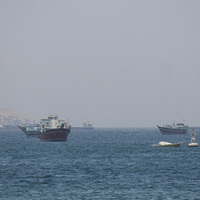
The most immediate impact has come through energy supplies. The blockage of the Strait of Hormuz has triggered what the International Energy Agency (IEA) has described as the largest supply disruption in the history of the global oil market, pushing up oil and gas prices as well as shipping costs.
According to a recent IEA report, global oil supply losses since February have reached 12.8 million barrels per day. Gulf producers affected by the closure of the strait are producing 14.4 million barrels per day less than before the war. Based on the daily shortfall of 12.8 million barrels, more than 1.2 billion barrels of supply have been affected since the conflict began, underscoring the strain on global energy inventories and transport capacity.
The IEA expects global oil supply in 2026 to remain, on average, 3.9 million barrels per day lower, even if shipping through the strait gradually resumes.
In a joint statement, the IEA and other bodies warned that if shipping fails to return to normal and global oil inventories continue to fall rapidly, global economic resilience could face serious risks.
The shock is not limited to oil. The World Bank expects global energy prices to rise 24 percent in 2026 because of the conflict. Overall commodity prices are projected to increase 16 percent, driven mainly by energy, fertilizer and some metals.
John Roper, chief executive for the Middle East at German energy company Uniper, said the strait's closure and damage to facilities took most of the gas supply growth between 2025 and 2026 off the market, warning that the pain from the supply shortfall could last at least until 2030.
INFLATION PRESSURES RETURN
The International Monetary Fund (IMF) said in a recent report that even under a scenario involving a short-lived conflict and moderate increases in energy and commodity prices, global inflation would reach 4.4 percent in 2026, significantly deviating from the recent disinflation trend.
Signs of renewed inflationary pressure have already appeared in Europe and the United States. U.S. gasoline prices in April were more than 50 percent higher than before the war, while real disposable personal income fell for a third consecutive month. In the eurozone, inflation in France, Italy, Spain and Germany has stayed above the European Central Bank's 2 percent target for three months in a row, with higher energy costs spreading into food and services prices.
"The longer the disruptions last, the larger the economic and social costs become," OECD Secretary-General Mathias Cormann said.
Developing economies face a heavier burden. The World Bank expects inflation in developing economies to average 5.1 percent in 2026, 1 percentage point higher than prewar forecasts.
"The poorest people, who spend the highest share of their income on food and fuels, will be hit the hardest, as will developing economies already struggling under heavy debt burdens," World Bank chief economist Indermit Gill said. "All of this is a reminder of a stark truth: war is development in reverse."
GROWTH OUTLOOK DARKENS
The conflict is also clouding the growth outlook.
The OECD expects global growth to slow from 3.4 percent in 2025 to 2.8 percent in 2026, down 0.1 percentage point from its March forecast. If disruptions to Gulf energy production and exports persist into 2027, global growth in 2026 could fall further to 2.1 percent.
The IMF has listed the Middle East conflict as a major test for the global economy, projecting growth to slow to 3.1 percent in 2026, down from its January forecast of 3.3 percent. The United Nations expects global growth of 2.5 percent, 0.2 percentage point lower than its January projection.
The war is weighing on growth through inflation, consumption and investment. Higher energy and raw material costs squeeze corporate profits and dampen investment appetite. Rising prices erode real incomes and curb consumer spending. Higher financing costs add pressure on companies and governments already carrying heavy debt burdens.
That leaves major economies facing a sharper policy dilemma. Slower growth, weaker consumption and higher business costs call for policy support, but rising energy prices and renewed inflation limit the scope for monetary easing. After the pandemic and years of high interest rates, many governments have less capacity to offset the energy shock through subsidies or tax cuts.